Most people use "broadband" as a catch-all word for internet, but the technology carrying that connection into your home makes a bigger difference than most plans admit.
What older broadband actually runs on
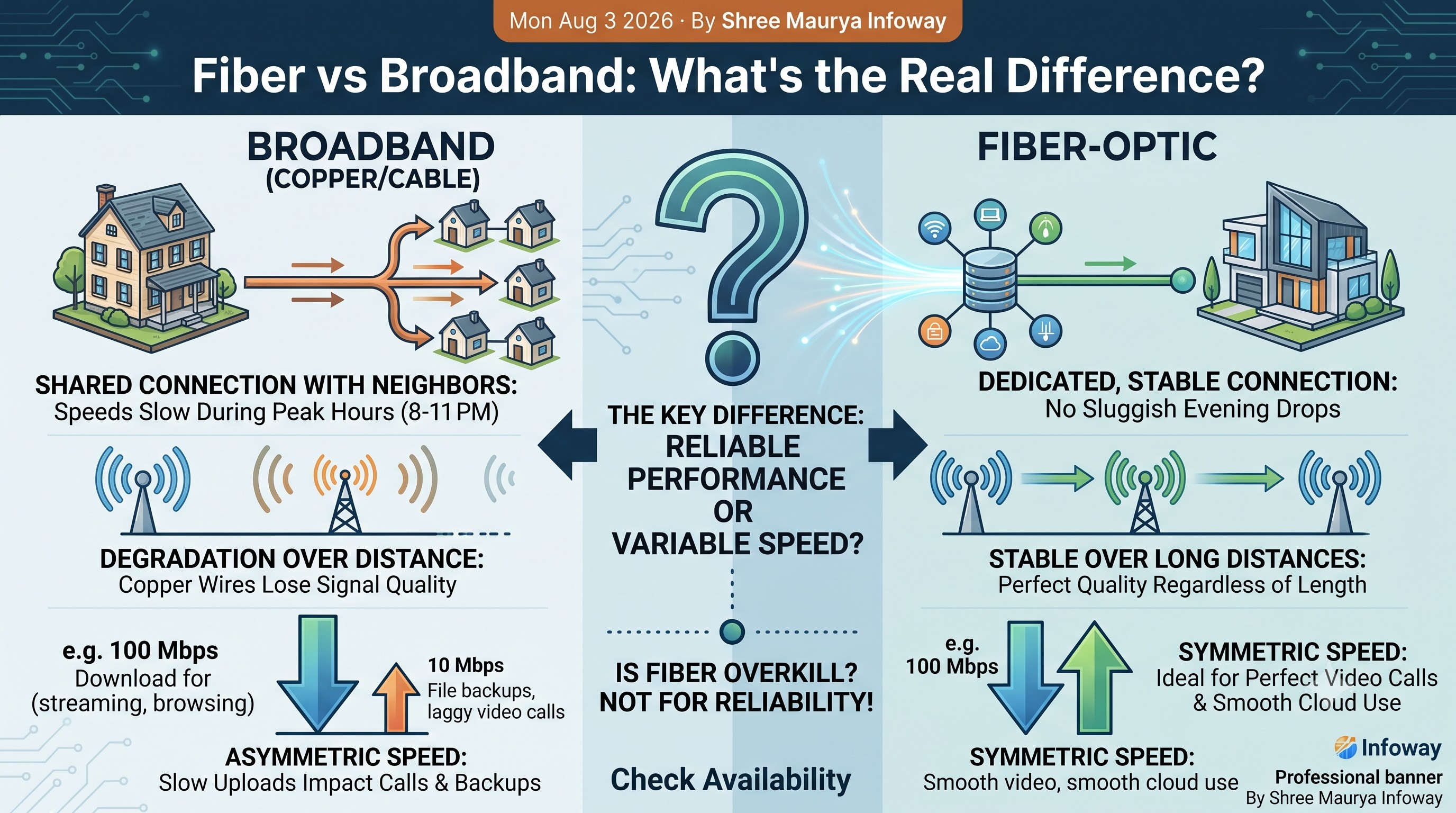
Cable and DSL connections travel over copper wiring — the same kind of cable originally built for telephone lines and TV signal. Copper works, but it degrades over distance and gets shared with neighbours on the same line, which is why speeds often drop during peak evening hours.
What fiber actually is
Fiber-optic cable sends data as pulses of light through glass strands instead of electrical signals through metal. That one change is why fiber connections support much higher speeds, stay stable over longer distances, and don't slow down just because everyone on your street is streaming at 9 PM.
Why upload speed is the part people miss
Copper-based plans are usually asymmetric — fast downloads, slow uploads. That's fine for watching videos, but it's exactly what breaks video calls, cloud backups and file uploads. Fiber plans are built for symmetric, or close to symmetric, speeds in both directions.
Is fiber overkill for a single-person home?
Not really — the difference shows up in reliability as much as raw speed. A stable 60 Mbps fiber connection tends to feel faster day-to-day than an unstable 100 Mbps copper one that dips every time a call comes in.
If you're not sure whether fiber is available at your address yet, check our coverage area or talk to our team — we'll tell you honestly what's actually running to your building.
Why this matters more as your household grows
The gap between fiber and copper-based broadband doesn't stay the same size — it widens as you add more devices, more people working from home, and more simultaneous streaming. A copper connection that felt adequate for one person can struggle noticeably once three or four people are actively online at the same time; a fiber connection tends to absorb that growth far more gracefully.